Nebraska is facing a difficult balancing act. The state’s struggling job market is pushing many STEM graduates to leave, while Nebraska’s record high property taxes are also discouraging companies from moving in. However, lowering property taxes could result in reduced funding for public schools.
To minimize the possible detrimental effects on Nebraska’s education system, many organizations are working to fill the void between classrooms and policymaking.
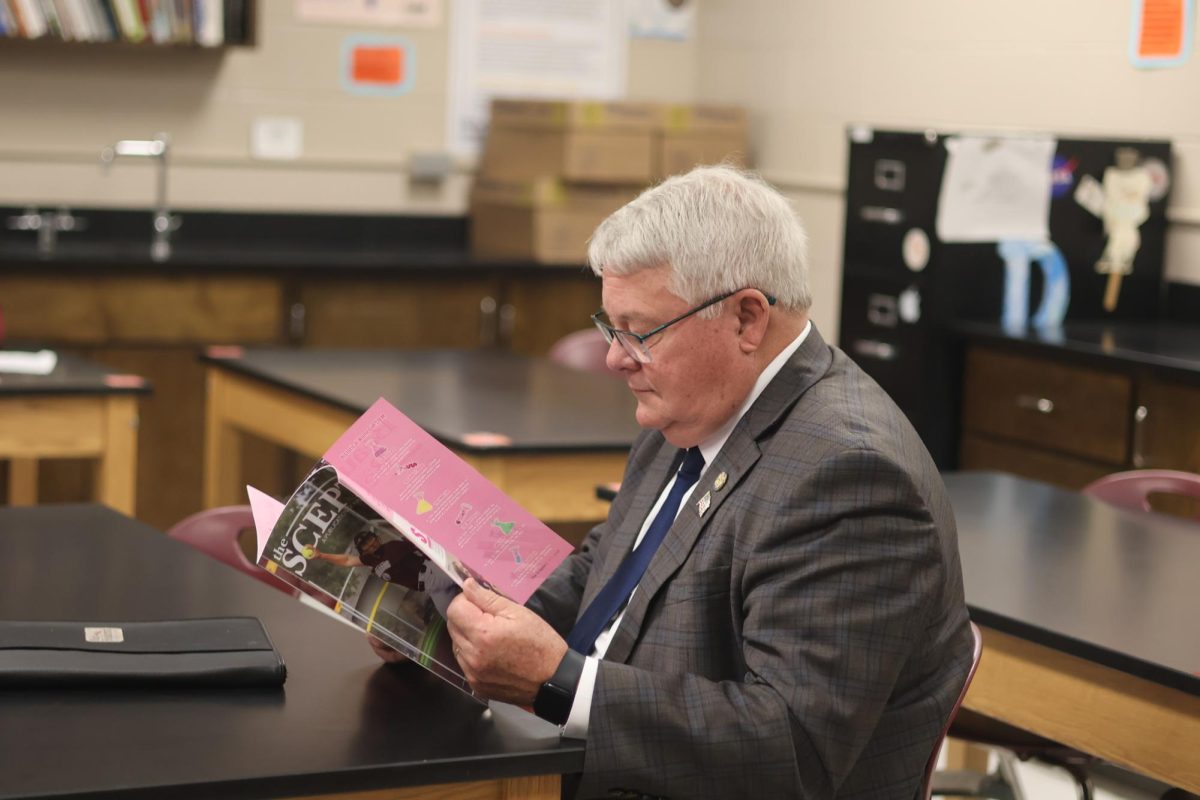
In November 2025, the Nebraska State Education Association (NSEA) invited twelve state senators to tour high schools across the state . The initiative was formed to help lawmakers to make the most informed education funding decisions through firsthand classroom insight. On Nov. 14, Senator Rick Holdcroft of District 36 toured Papillion-La Vista High School (PLHS), where he paid particular attention to the STEM classrooms.
“Things have advanced a lot in technology; that’s probably the main thing,” Holdcroft said. “I’ve been in astronomy and integrated math, and Algebra 2, and now Chemistry; and it’s still the same [curriculum], particularly in the technical fields. It is different, there’s obviously a lot more technology involved, but it’s still the same as far as the basics.”
The NSEA’s initiative comes amid a growing push for expanded STEM employment opportunities in Nebraska. With limited high-paying STEM jobs in the state, graduates often become structurally unemployed and leave to seek better salaries elsewhere. Some have even deemed this pattern as a systemic “brain drain.”
“We are agricultural, so most of our [economy] is not necessarily high STEM, but those are the high-paying jobs,” Holdcroft said. “We need to get more of those [STEM] companies to come to the state to be able to hire more people at those salaries. Otherwise, [graduates] get a college education and then they leave.”
This cycle of structural unemployment may not be due to a lack of educational opportunity for STEM majors. Every year, Nebraska’s universities continue to pump out an increasing number of STEM graduates. In fact, “U.S. News and World Report” ranks the University of Nebraska-Lincoln’s biological and agricultural engineering program ninth in the nation.
“I think a lot of our students stay in the state because of affordability, proximity to their families, familiarity with the schools, and all the opportunities,” PLHS counselor Wesley Caruso said. “When you put them side by side, there are just as many opportunities in state as there are out of state.”
Nebraska’s tax structure may be the catalyst in discouraging prospective STEM businesses. According to the Tax Foundation, Nebraska claims the fourth highest property tax rate in the United States. As a result, surrounding states such as Iowa and South Dakota have become much more appealing to business owners looking to move into the Midwest.
“It’s all about jobs and taxes, really,” Holdcroft said. “Reducing taxes is a goal. It’s hard to do because we are one of the highest property tax states, but sixty percent of property taxes are K to 12 education.”
In 1990, Nebraska adopted the Tax Equity and Educational Opportunities Act (TEEOSA) to distribute educational funds more equitably and to address high property tax concerns among residents. The act involves calculating a school’s allocated funding based on a complex formula based on eighteen factors, including student enrollment, poverty concentration and special education costs.
“So how do you reduce [property taxes]?” Holdcroft said. “I mean, what are you going to take away from education?”
After a long barrage of complaints surrounding unnecessary complications involving TEEOSA, including an gross miscalculation resulting in Omaha Public Schools being given and extra 30.5 million dollars of funding in 2025, some senators began to take action. In January 2025, Senator Jana Hughes introduced LB303, a proposed amendment to TEEOSA. The bill was later passed on June 4, 2025.
LB303 established an 18 member committee dedicated to amending the TEEOSA formula, as well as providing the Unicameral with annual propositions to reduce property taxes. Supporters of the bill, one of them being Holdcroft, hope that future edits to the equation will help foster the immigration of STEM companies into the state.
“As a state, we need to grow, because you need that base,” Holdcroft said.
It is a constant push and pull between supporting STEM graduates or education funding, and Nebraska’s lawmakers must decide the true cost of keeping talent.